There is a powerful account in Scripture that has always gripped me. The full story is found in Numbers 16 and 17, but here is the heart of it.
Korah, along with 250 leaders of Israel, men of reputation, respected and influential, rose up to challenge Aaron’s God appointed priesthood. Their argument sounded reasonable on the surface: “All the congregation is holy. The Lord is among us too. Why then do Moses and Aaron exalt themselves above the people?”
But this was not merely a question of leadership. It was a challenge to God’s order.
To settle the matter once and for all, the Lord gave a simple yet profound test. Each tribe was to bring a rod, a staff representing their house, and the man whom God had chosen would be revealed unmistakably. His rod would blossom.
Think about that for a moment.
These rods were nothing more than dry, lifeless sticks, cut from trees and completely dead. Yet God declared that the one He chose would come alive, bursting forth with buds, blossoms, and fruit. Life from death. A divine signature no man could imitate.
So each leader brought his rod. Aaron brought his. They were laid before the Lord.
By the next morning, something extraordinary had happened.
Out of all the rods, only one had changed. Aaron’s rod had come to life. It budded, blossomed, and even produced almonds. In a single night, what was once dead wood became a living testimony.
And with that, the matter was settled.
God had spoken, not with words alone, but with life itself.
Many centuries later, mankind still questions God’s chosen. The Lord Jesus Christ, in obedience to the will of the Father, came down to bear the punishment of sinners and bring reconciliation through His sacrifice. Jesus declared in John 14:6 KJV, “I am the way, the truth, and the life: no man cometh unto the Father, but by me.”
And the dissenting voices rise again. “How can Christ be the only way to the Father?” “All religions are just different paths to the same destination” “There are good people in every religion. Are they all wrong? “You’re just believing what you were raised to believe.” “We can do as good a job as Christ.” “I will take my chances. If I live a good life, that should be enough.” “You are arrogant to say He is the only way.”
As in centuries past, the Lord settles the matter the same way. It is simple.
“Bring your rods. Bring the Hindu rod, the Baptist rod, the Catholic rod, the Anglican rod, the Muslim rod, the Pentecostal rod, the Jehovah’s Witness rod, the LDS rod, the Christian Science rod, the rod of human reasoning. Bring them all, and bring Christ’s rod. Lay them down in the grave. The one I raise is the one I have chosen.”
And on that glorious morning, Christ’s rod budded. Christ’s rod budded!
Trace your heroes and you will find their graves still occupied. Those in whom men place their hope to reach the Father remain in the dust. The reason there is a Pope Leo XIV is because 13 other Pope Leos before him died and remained dead. Every system we cling to has leaders whose lives are marked by a beginning and an end on a tombstone. But Christ’s rod budded. Up from the grave He arose. Death could not hold Him.
The clock of life is ticking. One day, both hands of your clock will point to death. It will come, and there is nothing you can do to stop it. I once thought I had escaped death a few times. What a delusion. I cannot defeat death. I cannot outrun it. I cannot pray it away. I cannot outlive it by discipline or effort. Death has not yet come for me, because when it does, I will no longer be on this side of eternity. And when it comes for you, it will overcome you without effort.
But I have no fear of death, because it has lost its sting, which is sin (1 Corinthians 15:54–56). I have placed my trust in the One who died and rose again, the One who conquered death. Because of Him, I stand without condemnable sin. There is hope beyond the grave.
What, then, is your hope beyond death?
Religion will not save you. Only one rod budded. Only Christ conquered death. Only one way leads to the Father. Christ died for our sins according to the Scriptures, He was buried, and He rose again the third day according to the Scriptures (1 Corinthians 15:3–4 KJV). Believe on the Lord Jesus Christ, and thou shalt be saved (Acts 16:31 KJV). I urge you, I plead with you, abandon all hopes placed on religion, and cling to Christ, the one that budded.
John 1:3-4. All things were made by him; and without him was not any thing made that was made. In him was life; and the life was the light of men. (KJV)
The questions regarding the origin of the universe have always been there. Where did we come from? How did everything get here? Is there something else beyond this life? Am I part of something big? Does my life have any meaning? How did I get here? Every worldview, whether secular or religious, must answer these fundamental questions of life and purpose.
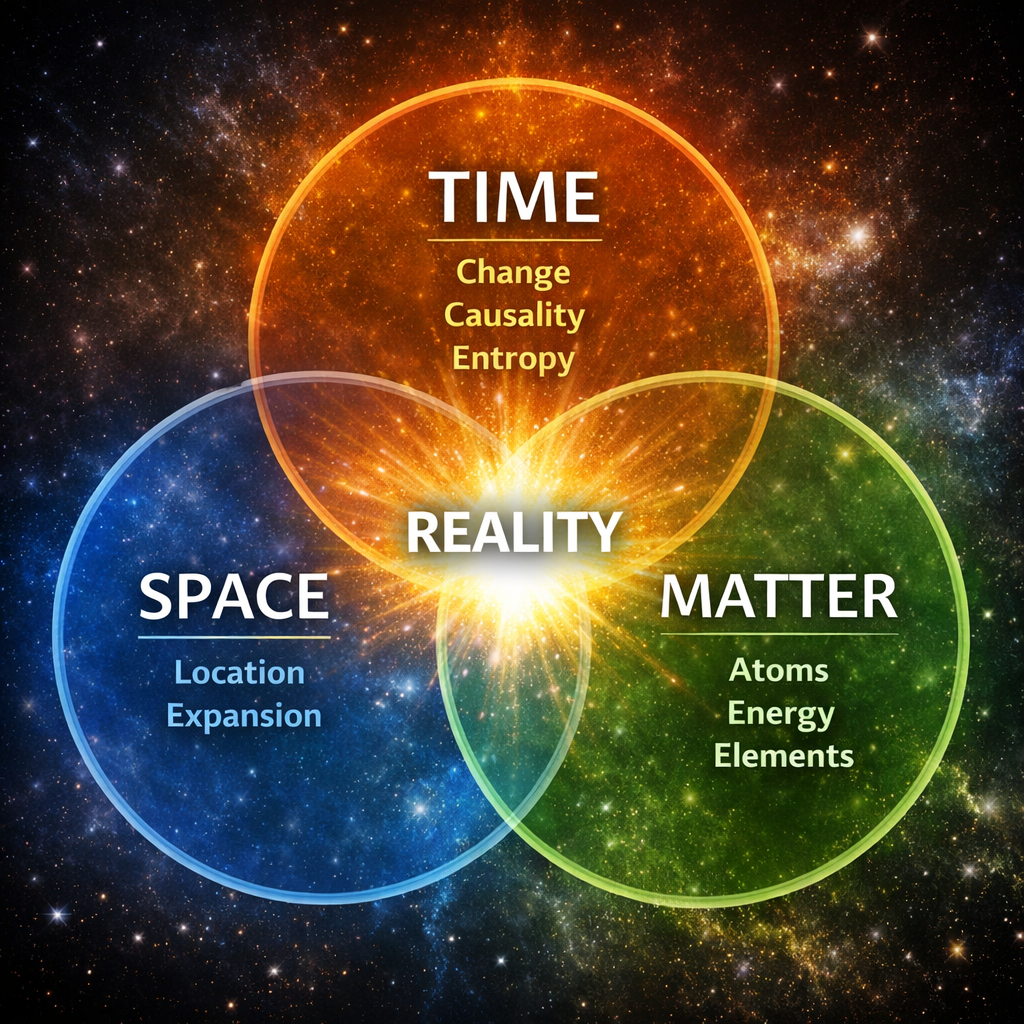
The three foundational components of our physical reality are time, space, and matter. These three are completely interdependent in the structure of reality and must come into existence together. If time is missing, there will be no change. If matter is missing, there will be nothing to change. If space is missing, there will be nowhere for anything to exist or for change to occur. They stand or fall together.
The Big Bang is the scientific model used to describe the origins of our universe. According to this model, space, time, matter, and energy began from an extremely hot, dense state. Space itself rapidly expanded, and as the universe cooled in the earliest fractions of a second, fundamental particles formed. These later combined into atoms, stars, galaxies, and planets.
But what was before the Big Bang? One scientific view suggests there was nothing before it because time itself began at the Big Bang. If time began there, then there cannot logically be a “before.” Other theoretical models—such as quantum vacuum states, inflationary pre-states, cyclic universes, or multiverse concepts—suggest there may have been something prior. Yet even those proposals lead to another question: what preceded that?
In the end, there is a measure of faith required in any origin explanation. The atheist may ask the Christian, “If God created everything, who created God?” and not see the hypocrisy its inherent hypocrisy. The same question could be posed about any proposed pre-Big Bang state. Every worldview must eventually account for an uncaused cause.
Genesis 1:1. In the beginning God created the heaven and the earth (KJV).
In the very first verse of the Bible, we are told of the origins of our Universe:
In the beginning (Time)
God created (Creator – outside of time)
The heaven (Space)
And the earth (Matter)
I have long been fascinated by disciplines that explore the wonders of creation, particularly astronomy and genetics. The universe is so vast that we require a special ruler to measure it: the light year. A light year is the distance light travels at 186,000 miles per second for one year. In miles, one light year equals 5.88 trillion miles. The observable universe is estimated to span approximately 93 billion light years in diameter—and that represents only what we can currently detect with existing technology!
Isaiah 44:24. Thus saith the Lord, thy redeemer, and he that formed thee from the womb, I am the Lord that maketh all things; that stretcheth forth the heavens alone; that spreadeth abroad the earth by myself. (KJV).
As vast as the universe is, Scripture describes God as stretching out the heavens. What overwhelms our imagination does not strain Him. Handling the universe for God is like folding laundry. We often underestimate the greatness of God because we have not truly grasped the greatness of what He has made.
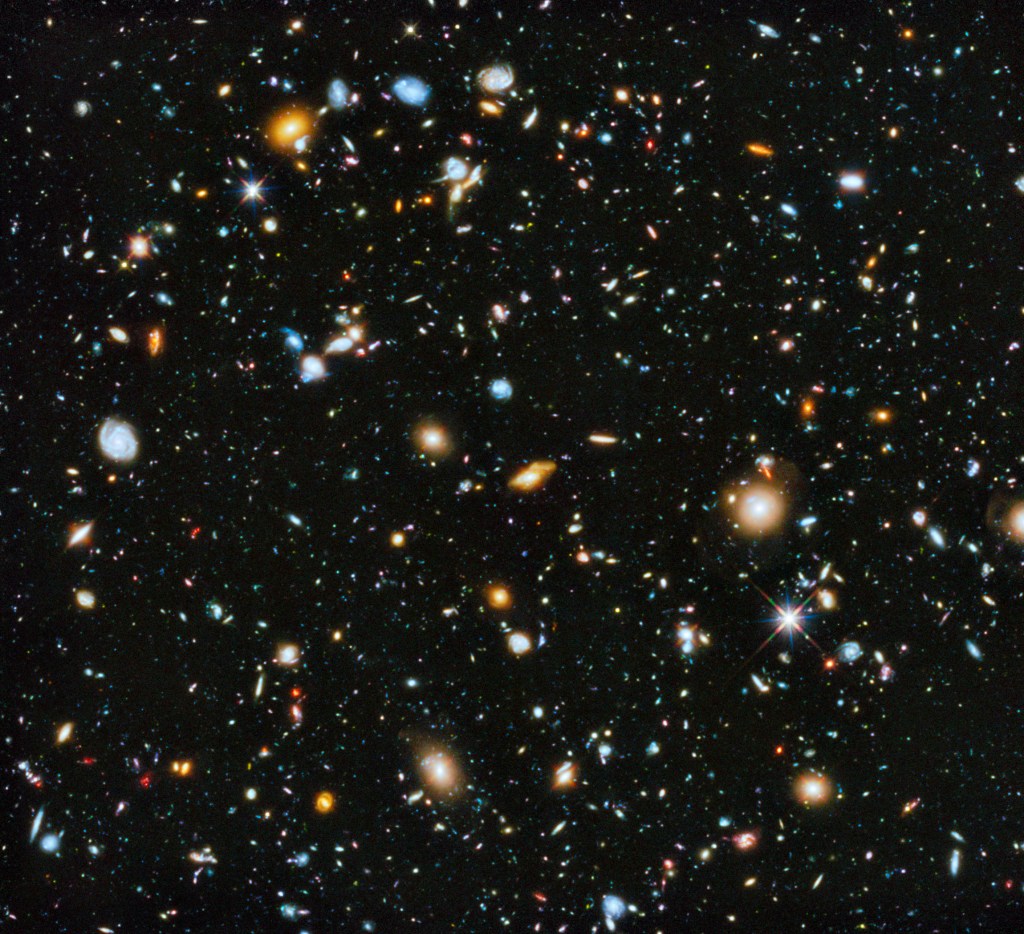
The building blocks of the universe are galaxies. A galaxy is a massive collection of stars, gas, and dust bound together by gravity. They range from about 10,000 to 100,000 light years in diameter. It is estimated that there are over two trillion galaxies in the observable universe, each containing millions to trillions of stars. The scale is staggering. Just how great must one be to keep record of all the stars in the universe?
Isaiah 40:25-26. To whom then will ye liken me, or shall I be equal? Saith the Holy One. Lift up your eyes on high, and behold who hath created these things, that bringeth out their host by number: he calleth them all by names by the greatness of his might, for that he is strong in power; not one faileth. KJV.
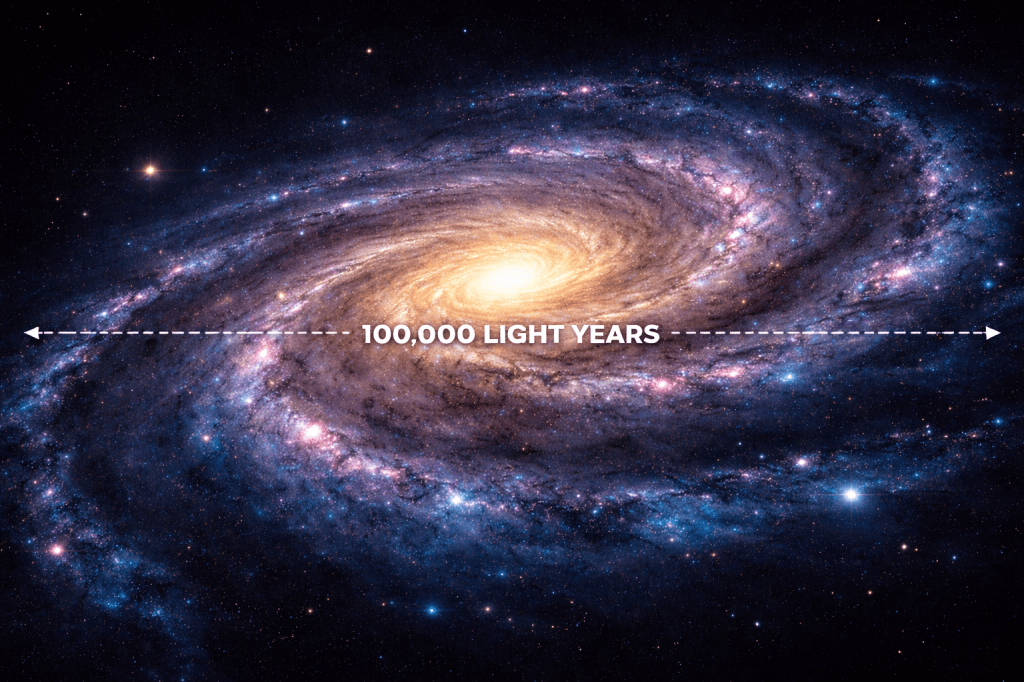
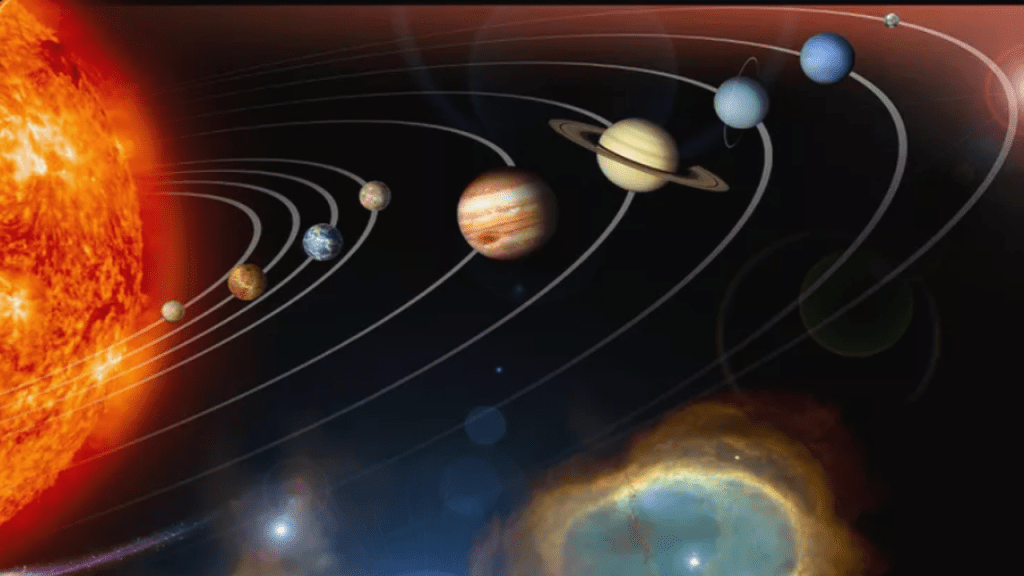
Of these galaxies, one is special to us because it contains our solar system: the Milky Way galaxy. It stretches roughly 100,000 light years across. Within its billions of stars, one is our sun. We sit about 93 million miles away from that blazing sphere of fire. One second of the sun’s energy output is comparable to billions of nuclear bombs detonated at once. Yet we are positioned at precisely the right distance.
Orbiting our sun are planets, including our home, Earth. Earth lies within what scientists call the “habitable” or “Goldilocks” zone. Its distance from the sun allows for an average temperature of 59°F (15°C), abundant liquid water, a protective magnetic field, and an atmosphere rich in nitrogen and oxygen—conditions necessary for life.
If Earth were slightly closer, like Venus, average temperatures would reach approximately 900°F (475°C), with thick carbon dioxide and virtually no water. If slightly farther, like Mars, temperatures would average -85°F (-65°C), with a thin atmosphere and mostly frozen water. Either scenario would make life as we know it impossible.
On this finely tuned planet, God placed life, with man as the crown jewel of His creation.
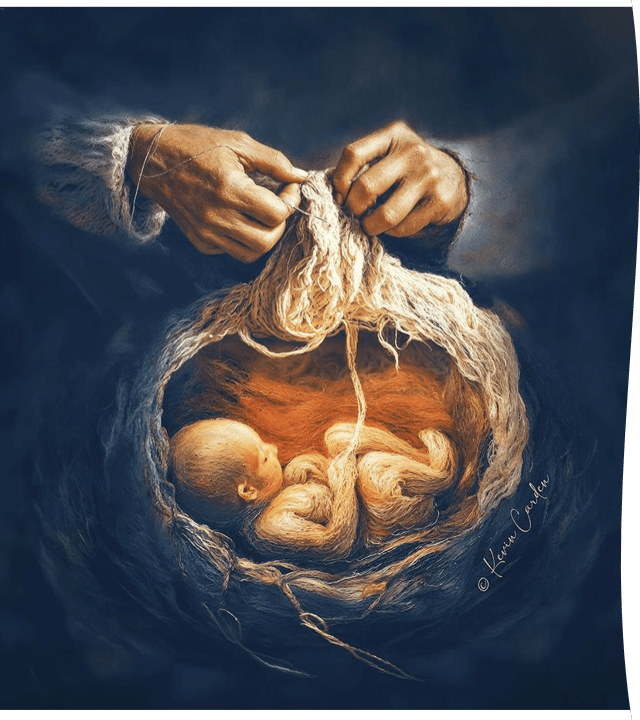
Psalm 139: 13-14. For thou hast possessed my reins: thou hast covered me in my mother’s womb. I will praise thee; for I am fearfully and wonderfully made: marvellous are thy works; and that my soul knoweth right well. KJV.
The human body contains trillions of cells, each containing approximately two meters of DNA. If the DNA in a single human body were stretched out end to end, it would span astronomical distances many times over. This intricate code carries the blueprint for growth, repair, coordination, and function.
Consider the living supercomputer of the brain, the precision of the eye, the constant battle waged by the immune system against invaders, and the complex electrical, chemical, and mechanical systems working in harmony. Even in a fallen world, the human body remains an astonishing testimony to design.
Now consider these two passages together:
Psalm 19:1-3. The heavens declare the glory of God; and the firmament sheweth his handywork. Day unto day uttereth speech, and night unto night sheweth knowledge. There is no speech nor language, where their voice is not heard. KJV.
The universe is not oversized by accident. It speaks. From the jungles to the cities, any person can look at the blazing sun by day or the star-filled sky by night and immediately sense two truths: there is a God, and He is powerful and glorious.
Yet not all acknowledge this truth.
Romans 1: 18-23. For the wrath of God is revealed from heaven against all ungodliness and unrighteousness of men, who hold the truth in unrighteousness; (what truth are they holding in unrighteousness?) Because that which may be known of God is manifest in them; for God hath shewed it unto them. For the invisible things of him from the creation of the world are clearly seen, being understood by the things that are made, even his eternal power and Godhead; so that they are without excuse: (Two-factor authentication of God: one, you can look at creation and know that there is no creation without a creator; and two, this truth is manifest in them, coded into man’s conscience. This is the truth that they hold in unrighteousness) Because that, when they knew God, they glorified him not as God, neither were thankful; but became vain in their imaginations, and their foolish heart was darkened. Professing themselves to be wise, they became fools, (In an effort to suppress the truth they really do know, they made up other conclusions. Observing creation and coming to any other conclusion other than that there is a God and He is powerful is vain imaginations and foolish Prov. 14:1) and changed the glory of the uncorruptible God into an image made like to corruptible man, and to birds, and fourfooted beasts and creeping things(the glory that should go to God goes into saying we evolved from apes, or attributing deity status to the created). KJV.
Creation testifies. Conscience affirms. Yet truth can be suppressed. The evidence of a Creator is visible in what has been made and internally sensed within man.
To conclude, we return to the primary text:
John 1:3-4. All things were made by him; and without him was not anything made that was made. In him was life; and the life was the light of men. (KJV).
The Lord Jesus is the absolute Governor of all things created. It is all His by right of creation. If there is life, it originated in Him and continues because of Him. Humanity alone is said to receive “light” — spiritual awareness, the capacity to know God. Man is set apart because God has given us the knowledge of Him and the possibility of relationship with Him.
Creation points beyond itself. Life points to its Source. And the light given to men calls us back to our Creator.
John 1:1–2 In the beginning was the Word, and the Word was with God, and the Word was God. The same was in the beginning with God.
Few doctrines in Christianity stir as much debate, confusion, and criticism as the doctrine of the Trinity. Interestingly, the word “Trinity” itself never appears in the Bible. Neither do words like “Rapture” or “Advent.” Yet Christians across centuries have rightly believed these teachings because the truths behind them are plainly taught in Scripture.
When the Bible speaks of what we now call the Trinity, it uses the term “Godhead,” a word that appears three times in Scripture. The doctrine itself can be summarized simply—though not easily explained: there is one God who exists eternally in three persons. God is not divided, yet He is not solitary. He is one in essence, three in person.
This truth stretches the limits of human understanding. In fact, it may be impossible to fully explain. And history shows that when believers try too hard to explain the Trinity—especially in an effort to silence critics—they sometimes drift into serious doctrinal error.
One such error is polytheism, where the attempt to defend the Trinity accidentally results in three gods. That directly contradicts the clear teaching of Scripture: “The LORD our God is one LORD” (Deuteronomy 6:4), and “I am the LORD, and there is none else, there is no God beside me” (Isaiah 45:5).
Another error is modalism, the idea that God is one person who simply wears three different masks at different times. This view erases the real distinctions between the Father, the Son, and the Holy Spirit—distinctions the Bible clearly maintains.
The purpose of this writing, then, is not to unravel the mystery of the Trinity or reduce it to human logic, but to show plainly that the Trinity is a biblical doctrine.
Scripture itself testifies: “For there are three that bear record in heaven, the Father, the Word, and the Holy Ghost: and these three are one” (1 John 5:7). And if the Bible translation you are holding omits or alters this verse, it is worth pausing to ask why one of the clearest statements on the Trinity would be removed.
The Persons of the Trinity
A person is more than a role or an appearance. A person is a distinct, self-aware, relational being—someone with identity, will, and the ability to relate to others.
The Father is described as a person in Hebrews 1:3, where Scripture speaks of the “express image of his person.” The Son is also identified as a person, as seen in 2 Corinthians 2:10, where forgiveness is spoken of as being granted “in the person of Christ.” The Holy Spirit, though not directly labeled “a person” in the same way, is clearly personal—He speaks, guides, teaches, and comforts. Jesus Himself refers to Him as the Comforter.
Each of these persons is described as fully God. The Father is God. The Son is God. The Holy Spirit is God. And yet, there are not three gods, but one God. This is not a contradiction—it is a mystery.
The Trinity Revealed in Salvation
The Bible reveals the Trinity in several powerful moments: in creation, at the baptism of Jesus, in prayer, and most beautifully, in salvation.
Hebrews 9:13–14 paints this picture clearly:
“For if the blood of bulls and of goats, and the ashes of an heifer sprinkling the unclean, sanctifieth to the purifying of the flesh: How much more shall the blood of Christ, who through the eternal Spirit offered himself without spot to God, purge your conscience from dead works to serve the living God.”
Under the Old Covenant, the high priest entered beyond the second veil once a year on the Day of Atonement. He himself was sinful. The sacrifice he brought was imperfect. It could not remove sin—only cover it temporarily.
But Christ was different. Born under the law yet without sin, He did what no Levitical priest could ever do. Once—and for all—He offered Himself.
And He did not do this alone.
The Son offered Himself to the Father, through the eternal Spirit. The Trinity was fully present in the work of redemption.
This raises an important question: What role did the Holy Spirit play in this sacrifice?
Scripture answers: “Without controversy great is the mystery of godliness: God was manifest in the flesh, justified in the Spirit” (1 Timothy 3:16).
Here is the picture. The Son of God entered the world in real human flesh and lived under the law. He faced temptation just as we do. For His sacrifice to be acceptable, He had to be perfectly sinless. Throughout His earthly life, the Holy Spirit bore witness to every thought, every action, every moment.
And when the time came for Christ to offer Himself, the Spirit testified to the Father: There is no blemish. No stain. No wrinkle. No sin.
He is righteous.
“Justified in the Spirit.” Declared perfectly righteous.
That testimony is recorded in Scripture itself: “He was in all points tempted like as we are, yet without sin” (Hebrews 4:15).
The sinless Son, vindicated by the Spirit, offered Himself to the Father. That offering paid the price for our redemption.
What a salvation this is. Planned by the Father. Accomplished by the Son. Testified and applied by the Spirit.
One God. Three persons. Perfectly united in saving us.
Sunday afternoon, 15th Feb 26, Faith Baptist Church Vermont
I don’t love beginning on a sober note, but sometimes that’s the only honest path to something meaningful. Stay with me—it doesn’t end where it starts.
There are truths that quietly, permanently reshape the way you see life. This is one of them.
Years ago, after visiting loved ones who had passed on, I would walk through a cemetery and read the tombstones. One detail was always the same: two dates, a birth and a death, separated by a small hyphen. That little line began to haunt me.
Every person who has ever lived has lived inside that hyphen.
Every joy and every sorrow. Every victory, every failure, every prayer whispered and every tear shed. The entire human experience is compressed into that small line between two dates. Some hyphens stretch long; others end far too soon. But every one of them is finite.
And then there’s sonder—the realization that every stranger you see has an inner life just as vivid and complex as your own. As real as my memories and emotions are to me, theirs were just as real to them. Yet when I stand before a tombstone, all of that depth—love, fear, laughter, regret—is reduced to a hyphen. I have no idea who they were. Just a line between two dates.
From Genesis 1 until now, there has always been the cycle of time: “the evening and the morning were the first day.” And so it has been ever since. “To every thing there is a season, and a time to every purpose under the heaven” (Ecclesiastes 3:1).
There was a season in my life when my biggest worry was whether dinner would be beans or jollof rice. Now my concerns are heavier, more complex. Time has a way of doing that.
Time itself is a strange thing. When did it actually begin? When did the first shadow move across the ground? When did the sand in the hourglass start to fall? When did the clock begin to tick?
John 1:1 — In the beginning was the Word.
“The beginning” refers to that precise moment on the number line when time started counting. If you could build a time machine and travel backward as far as possible, you would reach that point—and no further. And when you arrived, you would find that God was already there.
And if you traveled forward to the farthest possible future, to the end of time itself, you would discover the same truth: God is already there.
For God, there are no dates flanking the line, just have the hyphen. And even that image falls short, because God is not bound by time at all. Every event that has ever occurred in the universe has happened within time’s number line. God exists outside of it.
“I am Alpha and Omega, the beginning and the ending, saith the Lord, which is, and which was, and which is to come, the Almighty” (Revelation 1:8).
Try, for a moment, to think beyond time. What would that even be like?
We struggle with this because we are creatures of time. We measure life in years, distance in hours, and even speak of God as existing in “eternity past”—though “past” itself is a time-bound word. Still, Scripture tells us this much: before time existed, God is.
Jesus hints at that eternal reality in John 17:5: “And now, O Father, glorify thou me with thine own self with the glory which I had with thee before the world was.” Before creation, before time, the Godhead existed in perfect unity and glory. Our time-bound minds cannot fully grasp what that means.
And then something astonishing happened.
When the Word became flesh, God did not merely step into His creation—He stepped into time itself.
“But when the fulness of the time was come, God sent forth his Son, made of a woman, made under the law” (Galatians 4:4).
The God who exists outside the number line looked at a single moment within it and declared, This is the fullness of time. And then He entered it.
In His humanity, the eternal Son received a birthdate—though He had existed forever. He accepted a death date—though death could not hold Him. The timeless One subjected Himself to seasons, to waiting, to hunger and weariness, to joy and grief.
He experienced betrayal and sorrow, suffering and death—and then resurrection. He knew the weeping that endures for the night and the joy that comes in the morning. The eternal Word, the Lord Jesus Christ, lived the entire human story inside the hyphen.
Why does this matter?
Two verses tell us why.
First, “For when we were yet without strength, in due time Christ died for the ungodly” (Romans 5:6). The Eternal One entered time to redeem those bound by it.
Second, “For we have not an high priest which cannot be touched with the feeling of our infirmities; but was in all points tempted like as we are, yet without sin. Let us therefore come boldly unto the throne of grace, that we may obtain mercy, and find grace to help in time of need” (Hebrews 4:15–16).
He experienced the full ebb and flow of human life so that, when we suffer within our hyphen, we do not suffer alone.
He who had no beginning accepted a birth. He who could not die accepted death. So that those of us bound by time might live forever.
What a God we serve. What a God we serve.
Sunday Afternoon Service, Faith Baptist Church Vermont, 1st Feb. 2026.
13When Jesus came into the coasts of Caesarea Philippi, he asked his disciples, saying, Whom do men say that I the Son of man am? 14And they said, Some say that thou art John the Baptist: some, Elias; and others, Jeremias, or one of the prophets. 15He saith unto them, But whom say ye that I am? 16And Simon Peter answered and said, Thou art the Christ, the Son of the living God. 17And Jesus answered and said unto him, Blessed art thou, Simon Barjona: for flesh and blood hath not revealed it unto thee, but my Father which is in heaven.
This may be the most important question ever asked: Who is Jesus? Every person, at some point, must face it, whether they realize it or not.
Over the centuries many answers have been offered. He has been called a prophet, a teacher, a miracle worker, a political savior, a moral example, a social reformer, a highly evolved spiritual guide, even a spirit brother of Lucifer. Some simply see Him as a good man.
Scripture, however, does not leave Him in a category of human speculation. The purpose of this blog is to explore from the Bible what it teaches about the deity of the Lord Jesus Christ, especially for those in Christian circles who are being led astray by false teaching, whether through deliberate distortion or sincere misunderstanding of the Text. The question is too important to ignore and the answer too vital to leave unclear.
For those who already hold the Bible to be true, I ask only this: as we examine the evidence, consider the arguments as a whole. Try not to disengage when a particular point feels weaker than you might expect. Often clarity comes not from one statement standing alone, but from the cumulative weight of the evidence taken together. For those that have no doubt about this, I urge you to read as well. There is encouragement for you as we venerate our Lord Jesus Christ.
1. Old Testament Prophecies Point to His Deity
We are familiar with Isaiah 9:6. “For unto us a child is born, unto us a son is given: and the government shall be upon his shoulder:” And we can all collectively agree that this prophecy is made concerning the Lord Jesus (verse 7 makes this clearer). Verse 6 continues by saying “and his name shall be called Wonderful, Counsellor, The mighty God, The everlasting Father, The Prince of Peace.” Here, the Lord Jesus bears the title of God.
In Micah 5:2, we see the eternal origin of the Savior. “But thou, Bethlehem Ephratah, though thou be little among the thousands of Judah, yet out of thee shall he come forth unto me that is to be ruler in Israel; whose goings forth have been from of old, from everlasting. In fulfillment of this prophecy, the Lord Jesus was born in Bethlehem Ephratah centuries later and came from the tribe of Judah. Yet His origin is not confined to the manger. It stretches back into eternity, from everlasting.
2. The Works of Christ Prove His Deity
a. Creation and Sustenance
John 1:1-3. “1In the beginning was the Word, and the Word was with God, and the Word was God. 2The same was in the beginning with God. 3All things were made by him; and without him was not any thing made that was made.
Verse 14 of this chapter tells us that “the Word was made flesh,” and later in the chapter, the Word who was made flesh is identified by John the Baptist as the Lord Jesus Christ. We are also familiar with Genesis 1:1, which says, “In the beginning God created the heaven and the earth.” The Gospel of John reveals that the creation described in Genesis was accomplished through the Word, who is the Lord Jesus Christ.
Colossians 1:15-17. “15Who is the image of the invisible God, the firstborn of every creature: 16For by him were all things created, that are in heaven, and that are in earth, visible and invisible, whether they be thrones or dominions, or principalities, or powers: all things were created by him, and for him: 17And he is before all things, and by him all things consist.
Some may argue that the phrase “firstborn of every creature” means that Christ Himself is a created being, merely the first to be created. However, that is not what this passage teaches! The very next verse states that all things were created by Him. If Christ were Himself a created being, this would lead to an impossible conclusion, that Jesus created Himself. If He did not exist prior to creation, then creation itself could not exist.
Scripture clarifies this further in verse 18, where Christ’s being called “firstborn” speaks not of origin, but of preeminence. It is a title of supremacy and authority over all creation. Not only is the Lord Jesus the Creator of all things, He is also their Sustainer. As the passage declares, “By him all things consist.”
b. Forgiving sins
Mark 2:5-7. “When Jesus saw their faith, he said unto the sick of palsy, Son thy sins be forgiven thee. But there were certain of the scribes sitting there, and reasoning in their hearts, Why doth this man thus speak blasphemies? Who can forgive sins but God only?”
In one sense, the scribes are not entirely wrong. Isaiah 43:25 records the words of God: “I, even I, am he that blotteth out thy transgressions for mine own sake, and will not remember thy sins.” The answer to their question, “Who can forgive sins but God only?” is no one. Only God has the authority to permanently erase the record of sin.
What the scribes fail to recognize is that the One standing before them, who speaks forgiveness with divine authority, is God Himself.
c. Authority of God
People often say, “Only God can judge me,” usually as a way to avoid accountability or deflect correction. That discussion is for another time. What Scripture makes clear, however, is that the authority to judge as God has been given to the Lord Jesus Christ.
John 5:22. “For the Father judgeth no man, but hath committed all judgment unto the Son
3. The Worship of Christ Demonstrates His Deity
It is inbuilt in the heart of man to worship. A person who refuses to worship God will inevitably direct that worship toward someone or something else. In the passage below, we see Peter—yes, a Jew, yes, an Apostle of the Lord Jesus (a topic for another blog, as there are no living Apostles today according to Scripture)—being worshipped by a man.
If you ever find yourself in a position, whether by your own rise or by the elevation others give you, where people seek to worship you, your response must be like Peter’s.
Acts 10:25-26. “And as Peter was coming in, Cornelius met him, and fell down at his feet and worshipped him. But Peter took him up, saying, Stand up; I myself also am a man.”
So if I should not worship man, what about an angel? Surely an angel deserves worship.
Revelation 22:8-9. “And I John saw these things, and heard them. And when I had heard and seen, I fell down to worship before the feet of the angel which shewed me these things. Then saith he unto me, See thou do it not: for I am thy fellowservant, and of thy brethren the prophets, and of them which keep the sayings of this book: worship God.”
The angel’s response makes it clear: “I am not a man, but I am thy fellowservant. You cannot worship me. Worship God.” So, I cannot worship man, and I cannot worship angels. But what about the anointed cherub that covereth, as in Ezekiel 28:14? Surely that is a step higher.
During the temptation of Jesus, this cherub offered the same challenge:
Matthew 4: 9-10. “And saith unto him, All these things will I give thee, if thou wilt fall down and worship me. Then saith Jesus unto him, Get thee hence, Satan: for it is written, Thou shalt worship the Lord thy God, and him only shalt thou serve.”
The lesson is clear: man, angels, and cherubim are not worthy of worship. Only God is. If Jesus were not God and still accepted worship, He would be the greatest fraud, no different from Lucifer, who tried to entice mankind to worship him.
Yet angels are commanded to worship Him (Hebrews 1:6), and every knee will bow to Him—on heaven, on earth, and under the earth—everywhere (Philippians 2:10).
The Lord Jesus did not reject the worship of them in the ship, and Thomas
Matthew 14:33 Then they that were in the ship came and worshipped him, saying of a truth thou art the Son of God.
John 20:27-28. 27Then saith he to Thomas, Reach hither thy finger, and behold my hands; and reach hither thy hand, and thrust it into my side: and be not faithless but believing. 28And Thomas answered and said unto him, my Lord and my God
4. The Father Calls the Son “God”
Hebrews 1:8. “But unto the Son he saith, Thy throne O God, is for ever and ever: a sceptre of righteousness is the sceptre of thy kingdom.”
If God the Father Himself calls the Son “God,” then what more is there to discuss?
5. It was God that was manifest in the flesh
1 Tim. 3:16. And without controversy great is the mystery of godliness: God was manifest in the flesh, justified in the Spirit, seen of angels, preached unto the Gentiles, believed on in the world, received up into glory.
When we compare Scripture with Scripture, we see that the Word, Jesus Christ, was manifest in the flesh, as described in John 1. 1 Timothy 3:16 makes it unmistakably clear that the One who was manifest in the flesh is God Himself. Jesus is God.
6. It was God that died on the Cross
1 John 3:16. Hereby perceive we the love of God, because he laid down his life for us: and we ought to lay down our lives for the brethren.
Who laid down His life for us? Jesus Christ. This verse makes it clear that it was God Himself who gave His life. Therefore, Jesus is God.
7. The Blood of redemption was God’s
Acts 20:28. Take heed therefore unto yourselves, and to all the flock, over the which the Holy Ghost hath made you overseers, to feed the church of God, which he hath purchased with his own blood.
Notice carefully: who is the “he” that purchased the church of God with His own blood? God. And Scripture elsewhere tells us that we are redeemed by the blood of the Lord Jesus Christ. Bible with Bible, Jesus is God.
8. No mere mortal could claim to be the Savior of man
Hosea 13:4. Yet I am the Lord thy God from the land of Egypt, and thou shalt know no god but me: for there is no savior beside me.
This verse makes it unmistakably clear: there is no Savior apart from the Lord your God.
9. Religious leaders knew He claimed to be God
John 5:16-18. And therefore did the Jews persecute Jesus, and sought to slay him, because he had done these things on the sabbath day. 17 But Jesus answered them, My Father worketh hitherto, and I work. 18 Therefore the Jews sought the more to kill him, because he not only had broken the sabbath, but said also that God was his Father, making himself equal with God.
John 8: 58-59. Jesus said unto them. Verily, verily, I say unto you, Before Abraham was, I am. 59 Then took they up stones to cast at him:
You do not need to be an English scholar to notice that this sentence is grammatically unusual. Jesus is deliberately identifying Himself with the God who revealed Himself to Moses as “I AM” in Exodus 3:14. His Jewish listeners understood exactly what He was claiming, and their immediate response was to pick up stones to kill Him.
10. “Son of God” is God!
I have also heard the argument that Jesus is only the Son of God and not God. Consider this passage, which shows that claiming to be the Son of God is, in fact, a claim to be God.
John 10:30-33. 30 I and my Father are one. 31 Then the Jews took up stones again to stone him. 32 Jesus answered them, Many good works have I shewed you from my Father; for which of those works do ye stone me? 33 The Jews answered him, saying, For a good work we stone thee not; but for blasphemy; and because that thou, being a man makest thyself God. 34 Jesus answered them, Is it not written in your law, I said, Ye are gods? 35 If he called them gods, unto whom the word of God came, and the scripture cannot be broken; 36 Say ye of him, whom the Father hath sanctified, and sent into the world, Thou blasphemest; because I said, I am the Son of God.
The Jews were not trying to stone Him for His good works. They were accusing Him of blasphemy because, by calling God His Father and claiming to be the Son of God, He was asserting His own divinity.
I know this is longer than what I normally share, but I hope it has been deeply rewarding and encouraging. If it was not God Himself who paid the price for our sins, the righteous wrath of God would remain unsatisfied. Yet by believing that God, the Eternal Word, took on flesh, lived as a man, died, and rose again according to the Scriptures, we can receive eternal life. What a God! What a Savior!
Wednesday Night Bible Study; October 8, 25. Faith Baptist Church, Vermont.

 Kanayo Ikeh